NEWS
News & Information
1-Minute Guide to Waterproof Coating Application Methods
In construction projects, waterproofing is an essential step—whether indoors or outdoors, it must not be overlooked.
The application of waterproof coatings involves using professional equipment to apply the material onto surfaces. However, due to differences in coating types and properties, the methods vary accordingly, and improper technique may lead to unsatisfactory results. For different substrates and waterproof materials with varying characteristics, appropriate application methods should be selected to achieve optimal coating quality.
Below are several common waterproof coating application techniques.
01
Squeegee Method
The squeegee method uses tools such as steel trowels, angle trowels, flat scrapers, or flexible scrapers to evenly spread the base waterproof coating onto the substrate, forming a coating layer of the required thickness. This method is primarily suited for coatings with poor flowability, such as modified asphalt polyurethane coatings, MS sealants, or high-viscosity polyurethane coatings, typically applied at a thickness of 1.5mm. During application, the coating is first evenly distributed on the base surface, then smoothed with a squeegee to ensure uniform thickness, no sagging, no air bubbles, and a smooth surface. Allow it to dry thoroughly before proceeding.
Squeegee Application Precautions
① Apply even pressure when squeegeeing, keeping the squeegee angle at 50°–60° relative to the surface. Pressure should be consistent throughout.
② Control coating thickness by pre-setting metal strips (or wooden strips) on the squeegee edge or marking reference lines directly on the substrate. The height of the metal/wood strip must match the required coating thickness.
③ Squeegeeing should only be done 1–2 times; avoid multiple passes, as this can cause 'dry-in-the-middle' issues.
④ For curved or irregular surfaces, use a flexible scraper for application.
⑤ To speed up work progress, use segmented application: allow the first section to dry completely before applying the next. Segments are typically 0.8–1.0m wide for easier operation and to match the width of reinforcing materials.
⑥ Only proceed to the next coat after the previous layer has fully dried (minimum 12 hours). Do not apply a new layer if the previous one is still tacky, wet, or shows signs of sagging (or if sagging can rebound).
⑦ If air bubbles, uneven surfaces, cracks, or squeegee marks appear, repair immediately. Proceed to the next layer only after repairs are completed.
02
Roller Method
The roller method is widely used in construction waterproofing. It saves time and effort, is easy to operate, and offers four times higher efficiency than brushing on large, flat surfaces. Suitable surfaces include stone, concrete, plaster, floating slabs, metal mesh, sound-absorbing panels, and more.
Rollers come in long-nap, medium-nap, and short-nap types, as well as special flower-pattern rollers. Long-nap rollers apply thick coats but tend to create large air bubbles and excessive foam; short-nap rollers produce smoother, more visually appealing finishes; medium-nap rollers offer a balance between the two. Currently, medium- and short-nap rollers are most commonly used. Flower-pattern rollers can create unique decorative effects. When using rollers, always pair them with a paint tray.
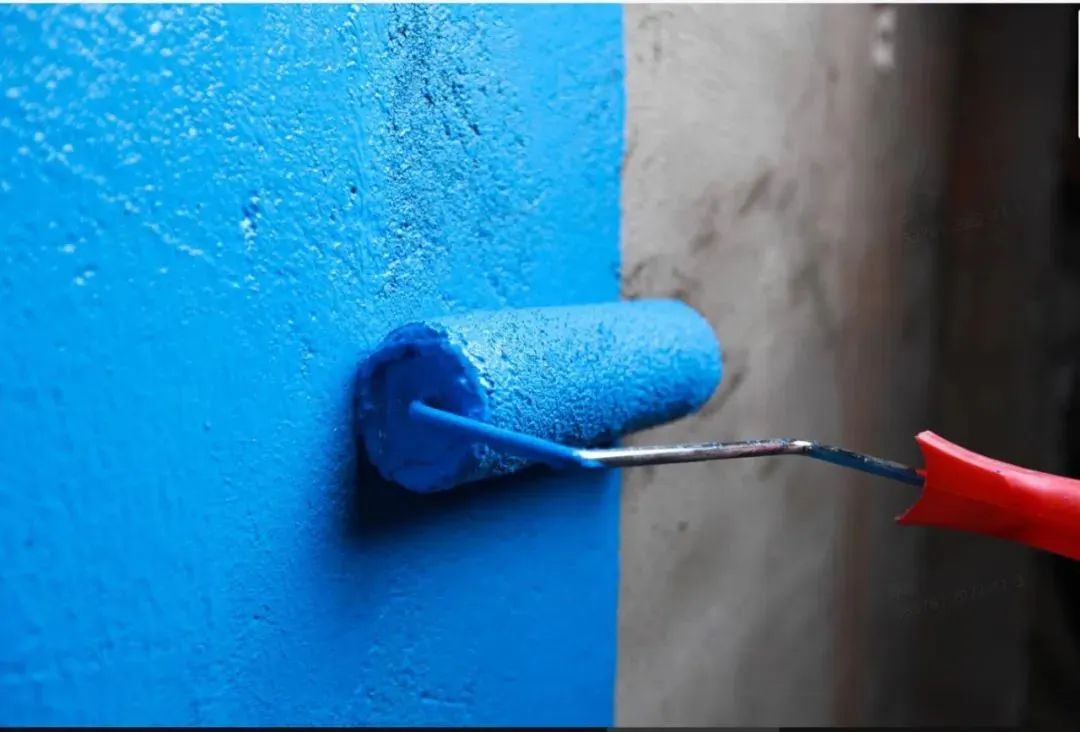
Roller Application Precautions
① Dip only half of the roller brush into the coating material, then roll it back and forth on the paint tray to distribute the coating evenly.
② Apply coating in a 'W'-shaped pattern from top to bottom, then horizontally roll to level the surface. If the roller becomes dry, lightly smooth the surface again.
③ Each pass width should be about four times the roller length, with one-third of the roller’s width overlapping the previous pass to prevent lap marks.
④ Apply even pressure on both ends of the roller during operation to ensure uniform coating. Start with slightly lighter pressure when the coating is abundant, gradually increasing pressure as the material depletes.
⑤ Avoid applying force with hands or arms—let the roller’s rotation do the work. Maintain a moderate rolling speed to prevent coating splatter and affect finish quality. Edge work should be light and performed from top to bottom. Use different-sized rollers depending on surface area, just like with brushing.
03
Brushing Method
The brushing method commonly uses a roller brush or a brush tool, mainly for coatings with good flowability and moderate thickness, such as JS, waterproof latex, applied at around 1.5mm in 2–3 layers. Refer to the diagram below:

Brushing Application Precautions
① Avoid trapping air bubbles in the coating layer. If air bubbles appear, remove them immediately. The number of coats must strictly follow pre-tested specifications—never over-thick applications to save time or effort. Wait for the previous coat to dry completely before applying the next. After drying, clean off any residue, dirt, or debris before proceeding to the next coat. Before applying subsequent layers, inspect the previous layer carefully for defects such as bubbles, sagging, leaks, cracks along reinforcement edges, or foreign matter contamination. Repair these issues before continuing.
② Apply vertical surfaces before horizontal ones. When coating vertical or horizontal areas, use either segmented or sequential application. When segmenting, ensure each segment matches the width of the reinforcement material to prevent workers from stepping on freshly coated areas. For less fluid coatings, segmented application can speed up work—allow the first section to dry before moving to the next.
③ Vertical coating should be applied before horizontal coating. The number of coats depends on the coating's flowability. Highly fluid coatings require multiple thin coats to avoid sagging. This prevents the upper layer from becoming thinner and the lower layer thicker, which could compromise the waterproof performance.
③ Uniform and precise coating application is key to ensuring quality. After brushing, apply the coating evenly and carefully according to the specified thickness (controlled by material quantity). Ensure each coat is applied perpendicular to the previous one to improve the overall integrity and uniformity of the waterproof layer. Overlap joints by 50–100mm during each pass, and extend overlap by 50–100mm beyond the joint to prevent leakage.

Latest News


Official Account
Chengdu:Huaqiao City, Jinniu District, Chengdu, Sichuan Province•Creative CenterABuilding 21, Floor 21 Manufacturing Base:No. 56 Xingye 7th Road, Industrial Economic Development Zone, Dayi County, Chengdu, Sichuan Province
Chongqing:Fujia No. 176, Haier Road, Jiangbei District, Chongqing68号 Manufacturing Base:No. 289 Qingsong Road, Tianjia Industrial Park, Tongnan District, Chongqing

National Consultation Hotline
028-87341118或15228990208
After-sales Service
400-0789-166
Copyright@ 2023 Sichuan Jinxing Waterproof Technology Group Co., Ltd. ShuICPBeian No. 2023005631-1


Baidu Baijiahao

Official Douyin
Mini Program Entry


15228990208