NEWS
News & Information
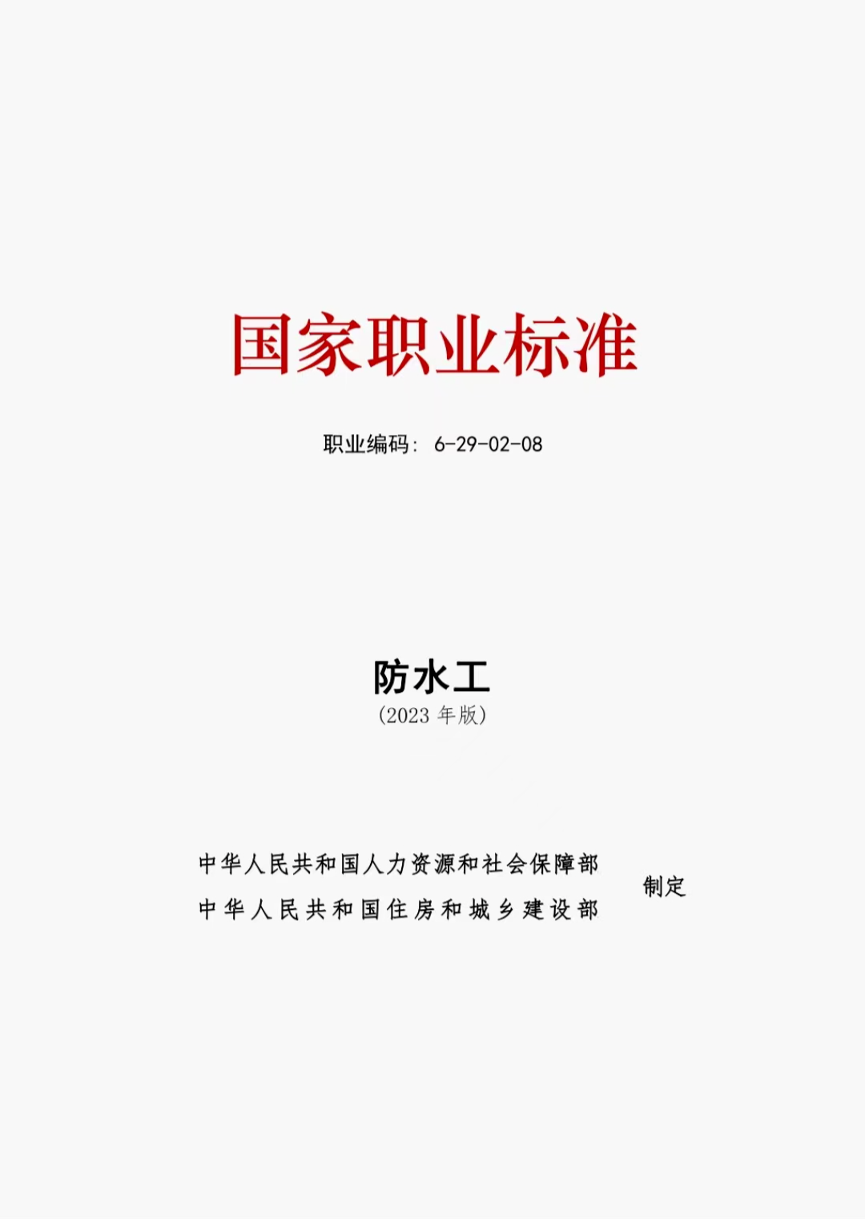
What are the differences between the 2023 edition and previous version of the National Occupational Standard 'Waterproofing Worker'?
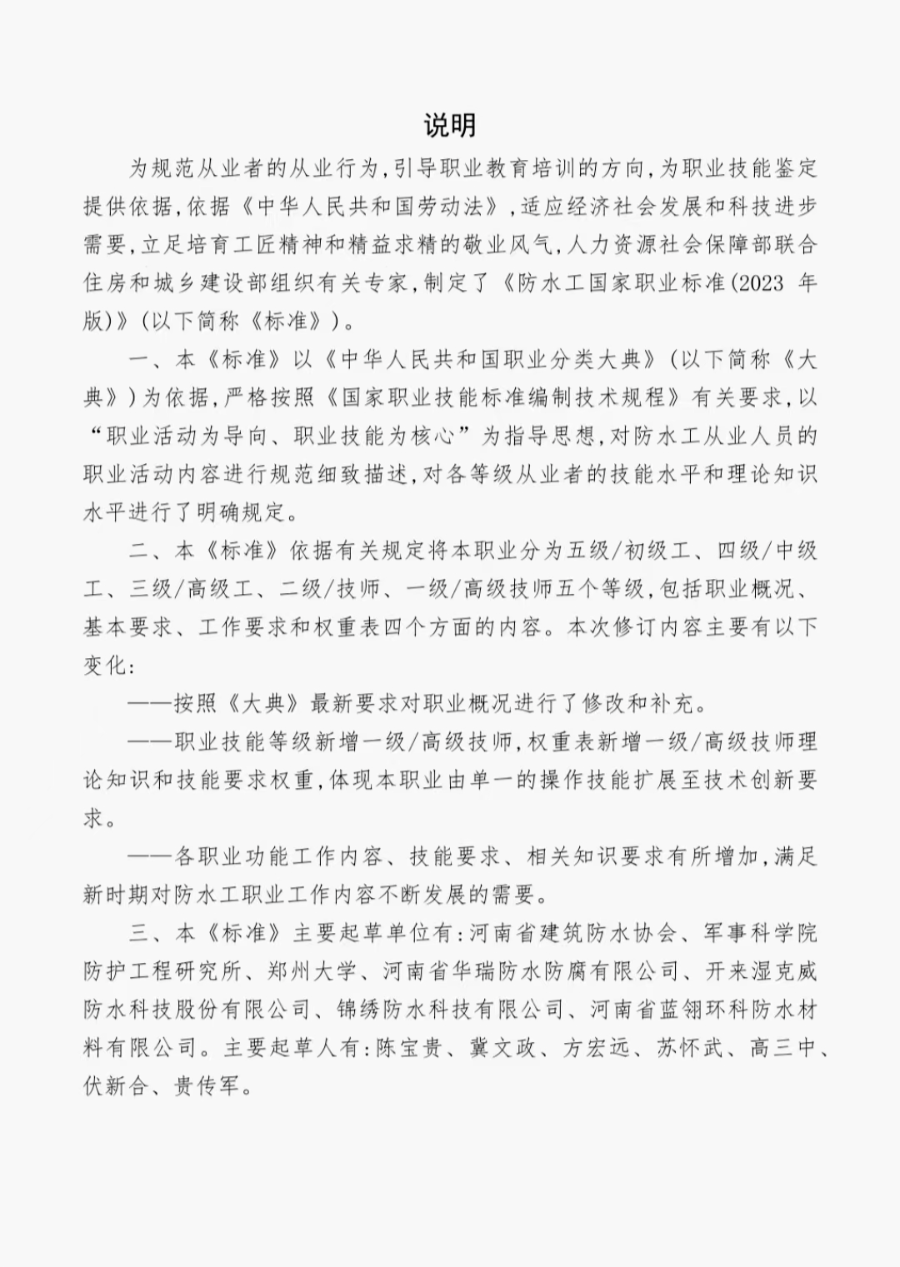
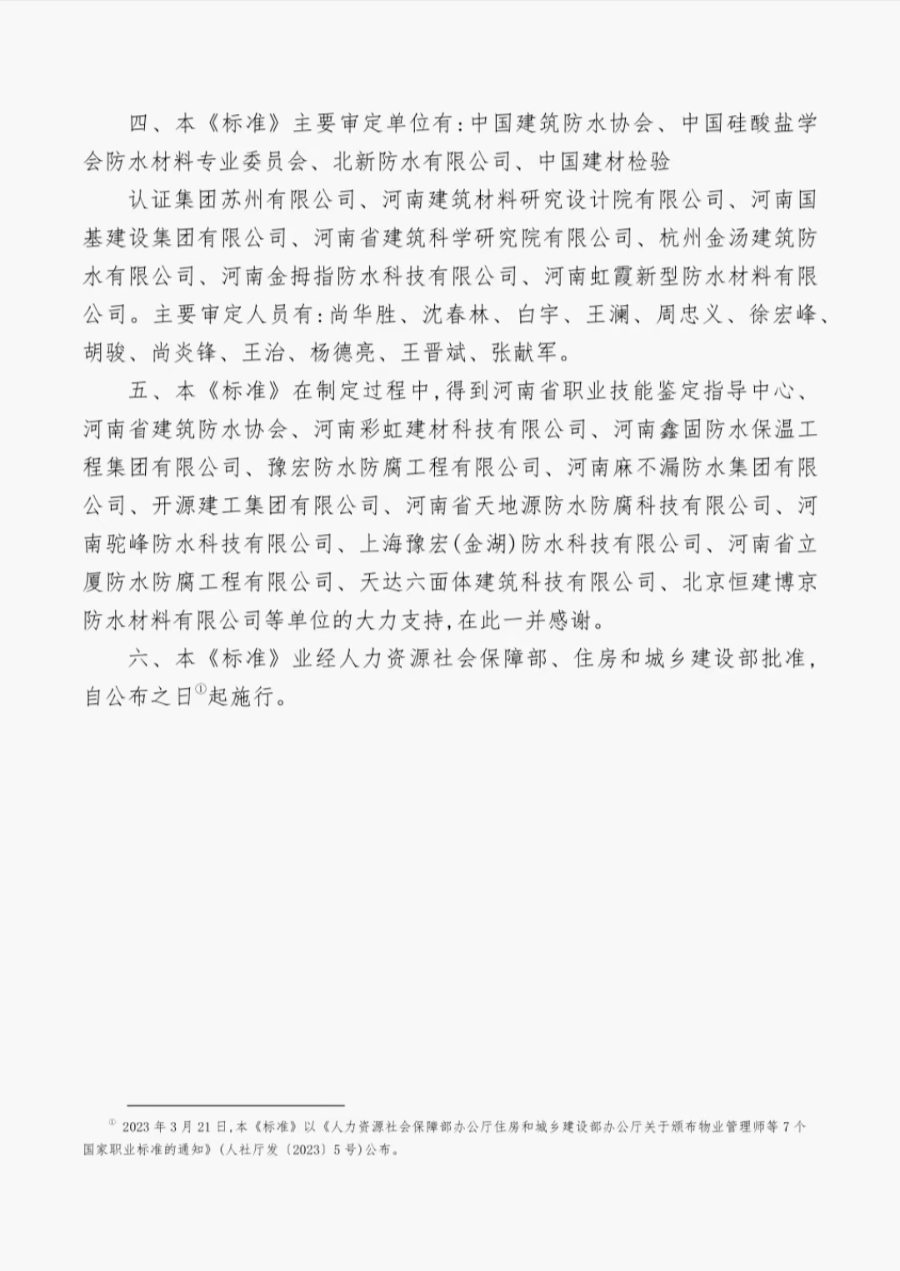
On March 21, the Ministry of Human Resources and Social Security and the Ministry of Housing and Urban-Rural Development jointly issued the notice 'Regarding the Publication of Seven National Occupational Standards Including Waterproofing Workers' (MOHRSS Document No. 5 [2023]), in which the occupational code for 'Waterproofing Worker' is 6-29-02-08, officially released on March 30. The release of this standard replaces the former national occupational (technical) standard. Compared with the previous version, the main changes in the new 2023 edition of 'Waterproofing Worker' include:
The new 2023 edition of 'Waterproofing Worker' mainly consists of four sections: occupational overview, basic requirements, job requirements, and weight tables; consistent with the previous version in structure. However, the occupational level has been upgraded from the original four levels to five levels, adding the Level 1 Senior Technician tier. The technical skill requirements have also been expanded from four levels to five levels, enabling a step-by-step progression to meet the country's growing demand for high-end skilled personnel. The previous version focused on simple construction requirements related to oil-based materials, sealants, and waterproof coatings. In contrast, the new version places greater emphasis on material application during waterproofing work, requirements for using modern tools, leakage control and treatment, as well as training and management throughout the construction process.
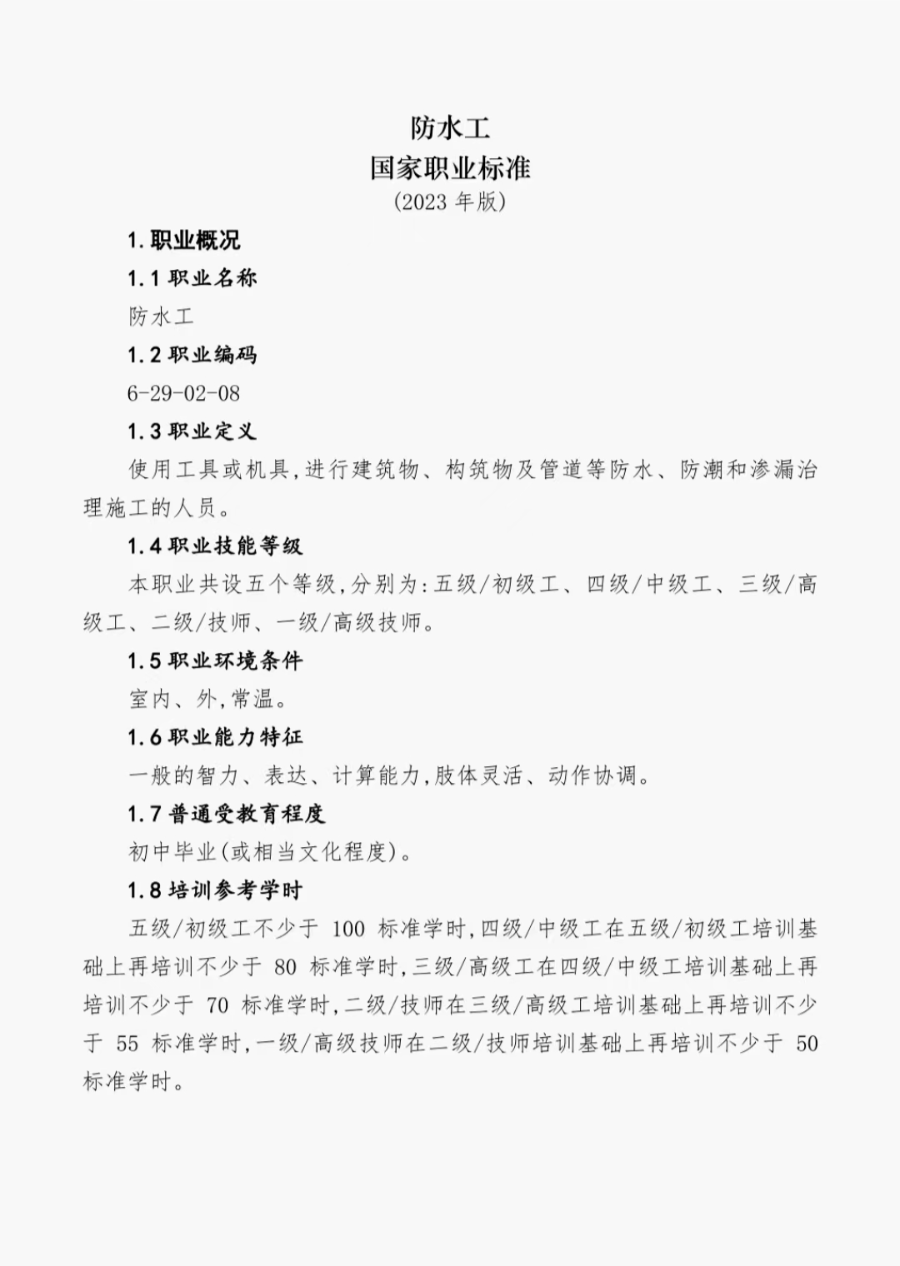
1.1 Consistency in Name, Code, and Description between New and Old Versions in the 'Chinese Occupational Classification Big Dictionary':
1.2 Occupational Skill Levels
This occupation now includes five levels: Level 5/Entry-level Worker, Level 4/Middle-level Worker, Level 3/Advanced Worker, Level 2/Technician, and Level 1/Senior Technician. Among them, Level 1/Senior Technician is newly added in the updated version. This level requires proficiency in applying specialized and unique skills across various fields within the occupation to complete complex and highly irregular tasks; mastery of core technical skills in the occupation; ability to independently handle and resolve highly challenging technical or engineering issues; innovation in technical research and engineering innovation; capability to organize and lead technological improvements and innovation activities; ability to conduct systematic professional skill training; and possesses technical management capabilities.
1.3 Working Environment Conditions
Indoor and outdoor, normal temperature.
Indoor and outdoor refer to the time spent by personnel engaged in this occupation working indoors and outdoors, respectively.
Normal temperature refers to working conditions where personnel spend more than 30% of their time in environments ranging from above 0°C to below 38°C.
1.4 Occupational Ability Characteristics
General intelligence, expression, calculation ability, physical agility, and coordination.
General intelligence primarily refers to learning ability—gathering, understanding, and comprehending external information—as well as analytical, reasoning, and judgment abilities.
Expression ability refers to the capacity to communicate and convey ideas effectively through spoken or written language.
Calculation ability refers to the capability to accurately and purposefully perform mathematical operations using numbers.
Hand-finger dexterity refers to the ability to quickly, accurately, and flexibly use fingers to complete predefined tasks.
Hand-arm agility refers to the ability to skillfully, accurately, and steadily use hands and arms to complete predefined tasks.
Motor coordination refers to the ability to swiftly, accurately, and harmoniously coordinate vision, hands, feet, and other body parts to produce appropriate responses and complete predefined tasks.
1.5 General Education Level refers to the minimum educational requirement that personnel must meet upon first entering this occupation.
1.6 Occupational Skill Certification Requirements
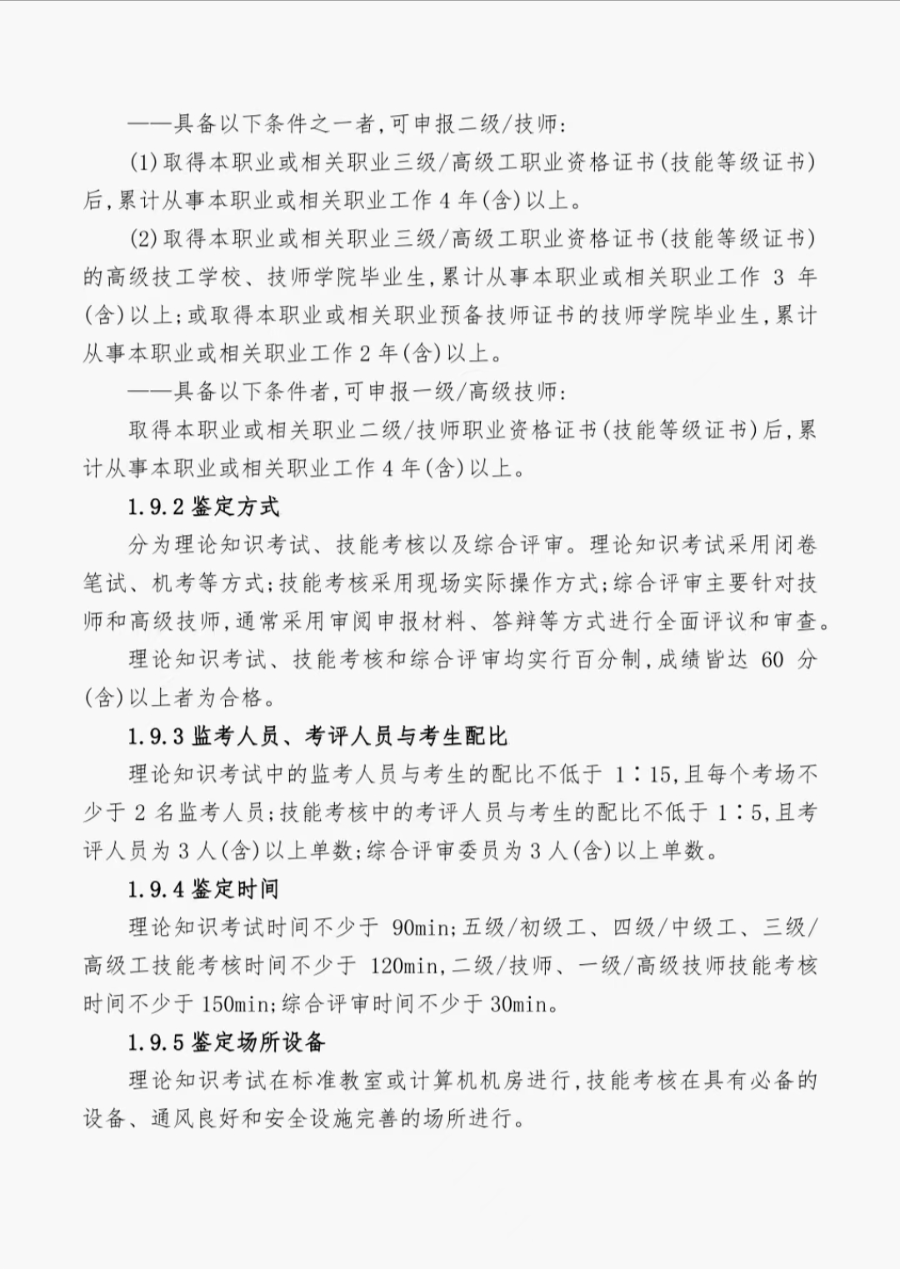
For Level 3/Advanced Worker, the application condition has been updated to include 'having worked in this occupation or a related occupation for seven years (inclusive) or more.' Meanwhile, the requirement previously stated as 'after obtaining a Level 4/Middle-level Worker qualification certificate (skill level certificate) in this occupation or a related occupation, having accumulated at least five years (inclusive) of relevant work experience' has been revised to 'after obtaining a Level 4/Middle-level Worker qualification certificate (skill level certificate) in this occupation or a related occupation, having accumulated at least three years (inclusive) of relevant work experience.' This change provides an opportunity for older workers and those in related occupations, offering protection to increase the supply of qualified waterproofing workers.
1.7 Assessment Method
Theoretical knowledge examination mainly assesses whether candidates possess the basic requirements and relevant knowledge required for working in this occupation.
Skill assessment mainly evaluates the candidate’s actual skill level in performing tasks related to this occupation.
1.8 Assessment Duration refers to the minimum required time for theoretical knowledge exams, skill assessments, and comprehensive evaluations at each level.
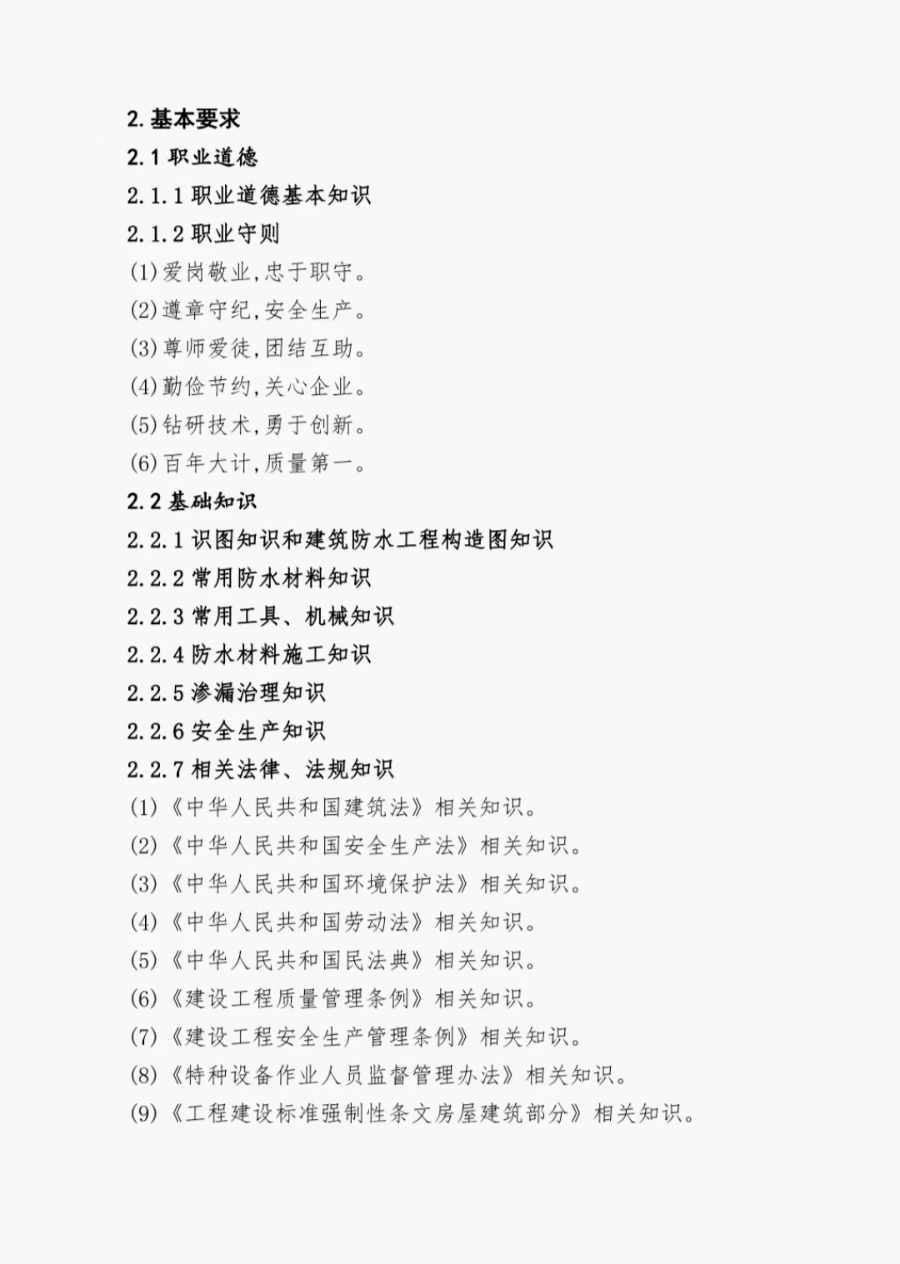
1.9 Basic Knowledge: The section on 'basic knowledge of building construction' has been revised to 'related knowledge of construction waterproofing engineering drawings,' with additional content including leak control and treatment knowledge. In the sections on relevant laws and regulations, knowledge about product standards for waterproofing materials and engineering construction standards has been added.
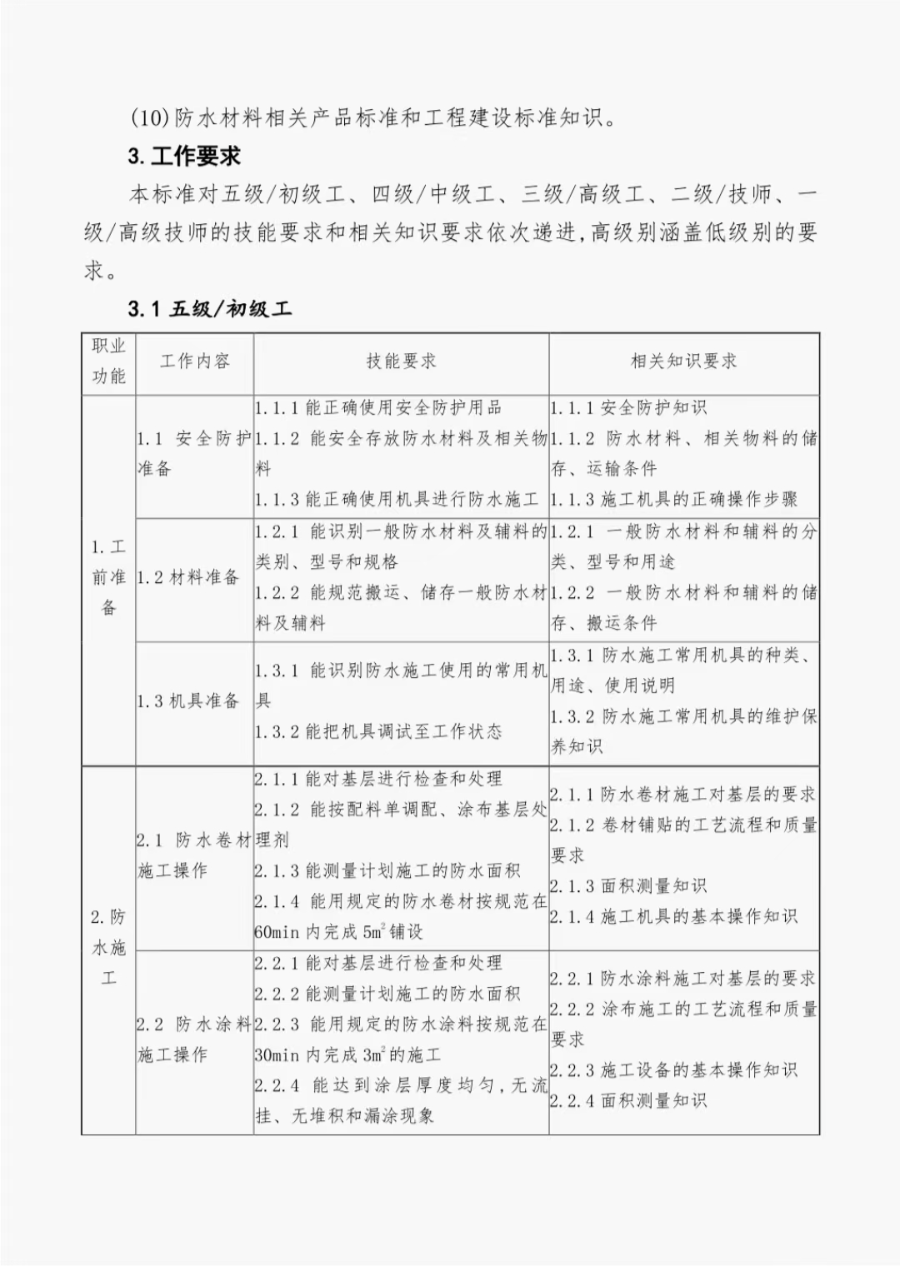
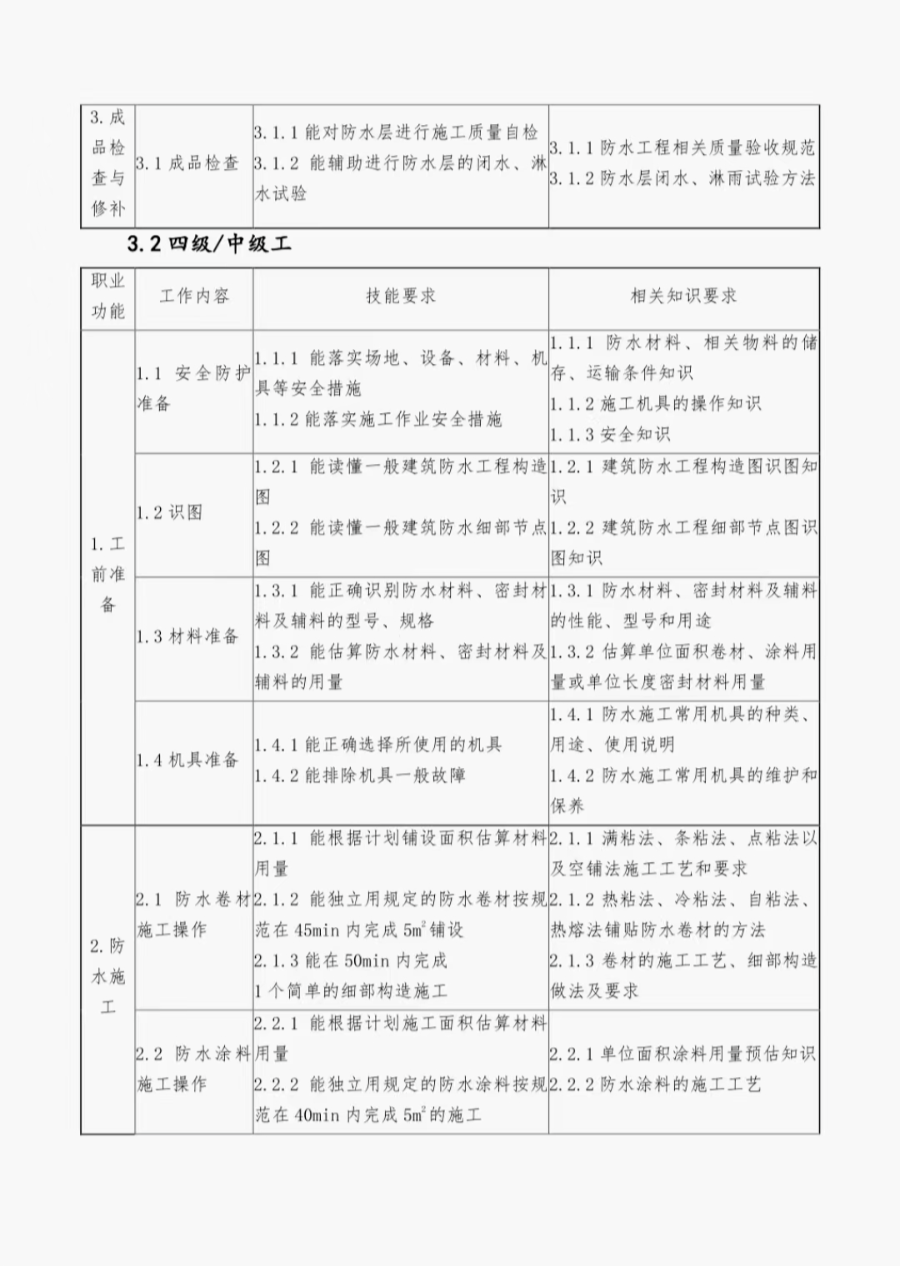
1.10 Job Requirements: Based on the analysis and refinement of occupational activities, this section describes the specific skill and knowledge requirements necessary for personnel to successfully complete their job responsibilities. The standard comprises five levels, with skill and knowledge requirements progressively increasing from lower to higher levels. Job requirements include four components: occupational functions, work content, skill requirements, and relevant knowledge requirements—forming the core part of the standard.
1.11 Occupational Functions refer to the work objectives that personnel need to achieve, or the main areas (activity items) of occupational activities.
1.12 Work Content refers to the tasks required to fulfill occupational functions, serving as a detailed breakdown of occupational functions.
1.13 Skill Requirements refer to the results or competencies needed to accomplish each task, representing the detailed breakdown of work content.
1.14 Relevant Knowledge Requirements refer to the essential knowledge required to meet each skill requirement. These are specific knowledge points, not broad knowledge domains.
1.15 Weight Tables are divided into theoretical knowledge weight tables and skill requirement weight tables, listing the relative importance of each level’s requirements in training, skill certification, and evaluation.
Full text of the 2023 Edition National Occupational Standard 'Waterproofing Worker' is available below ▼▼▼

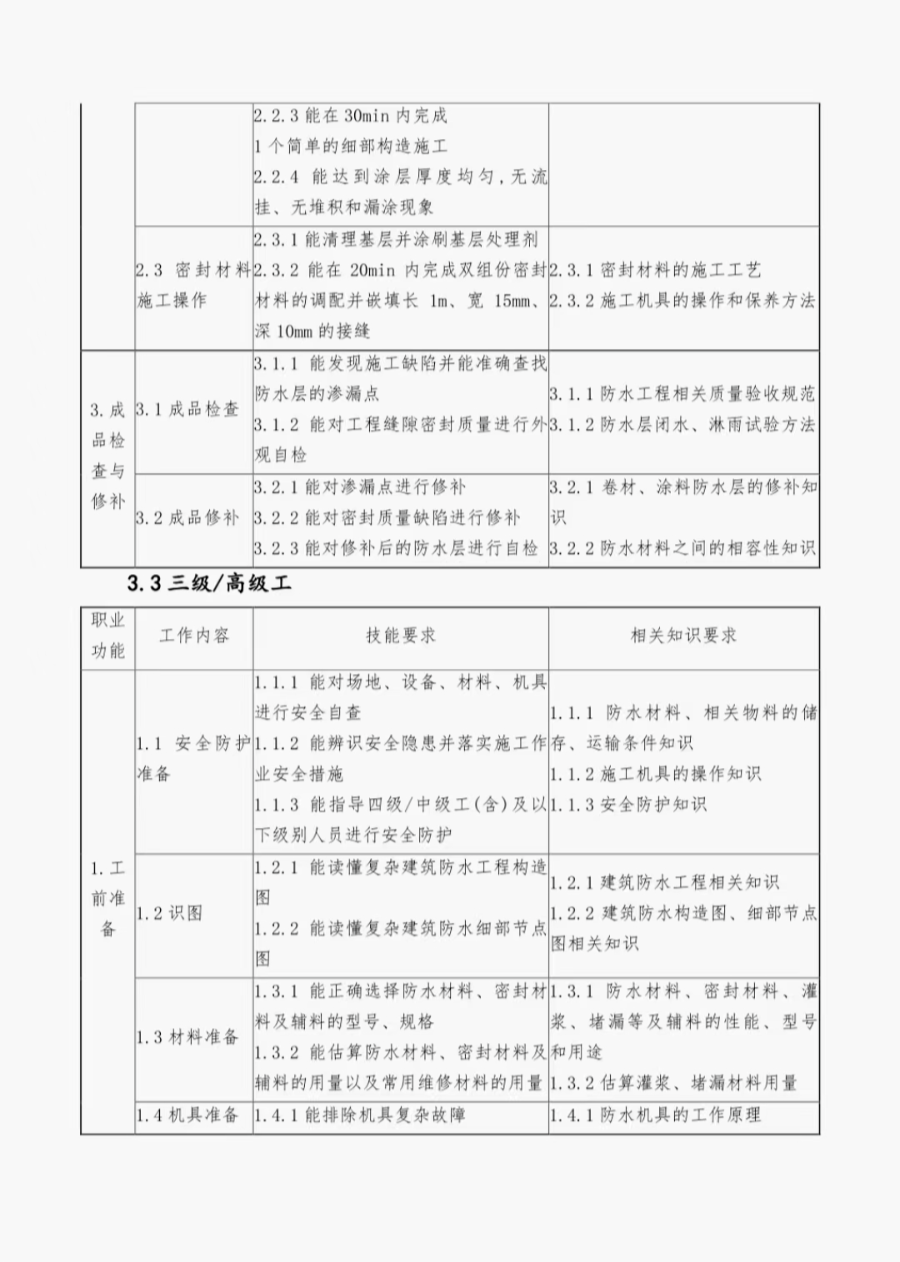
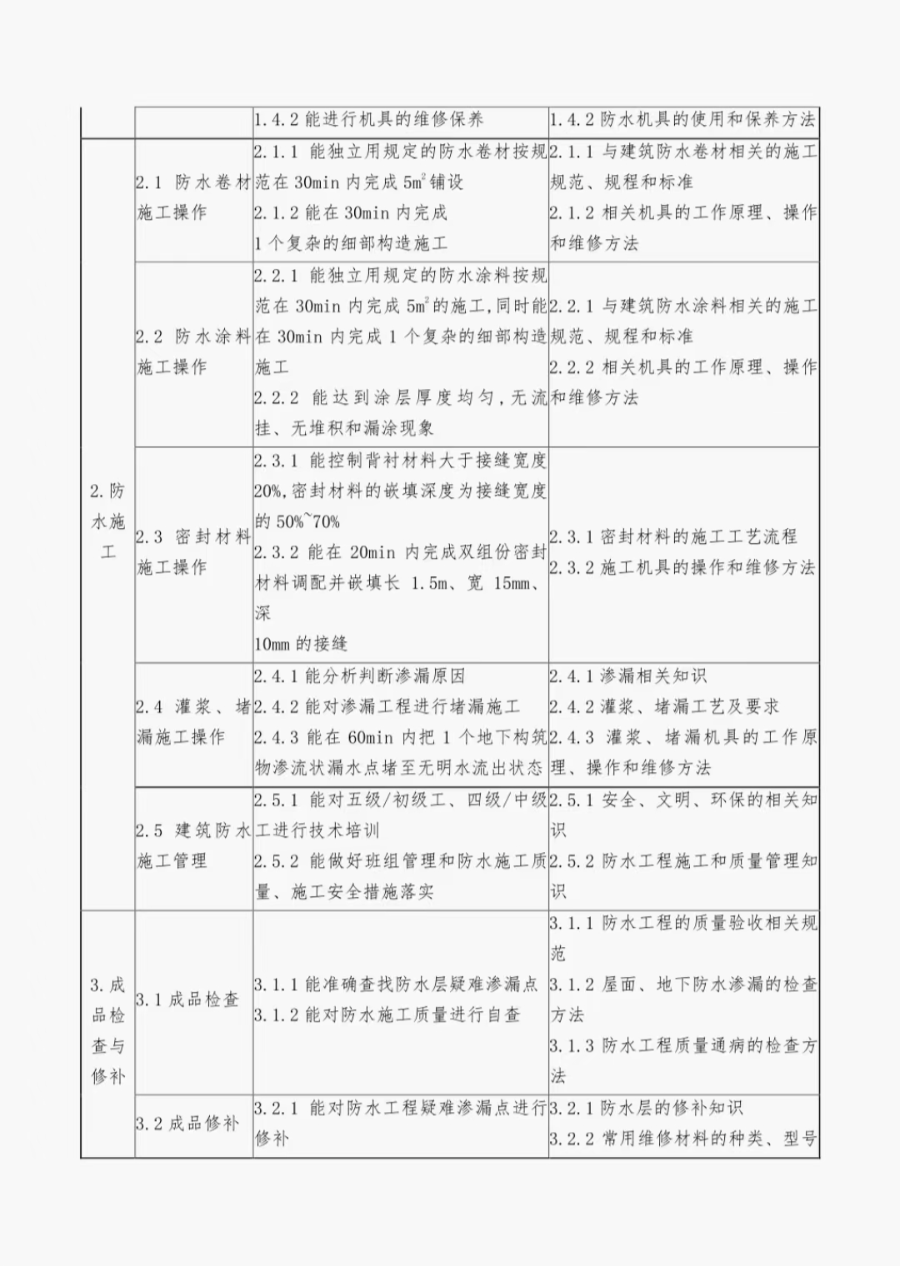
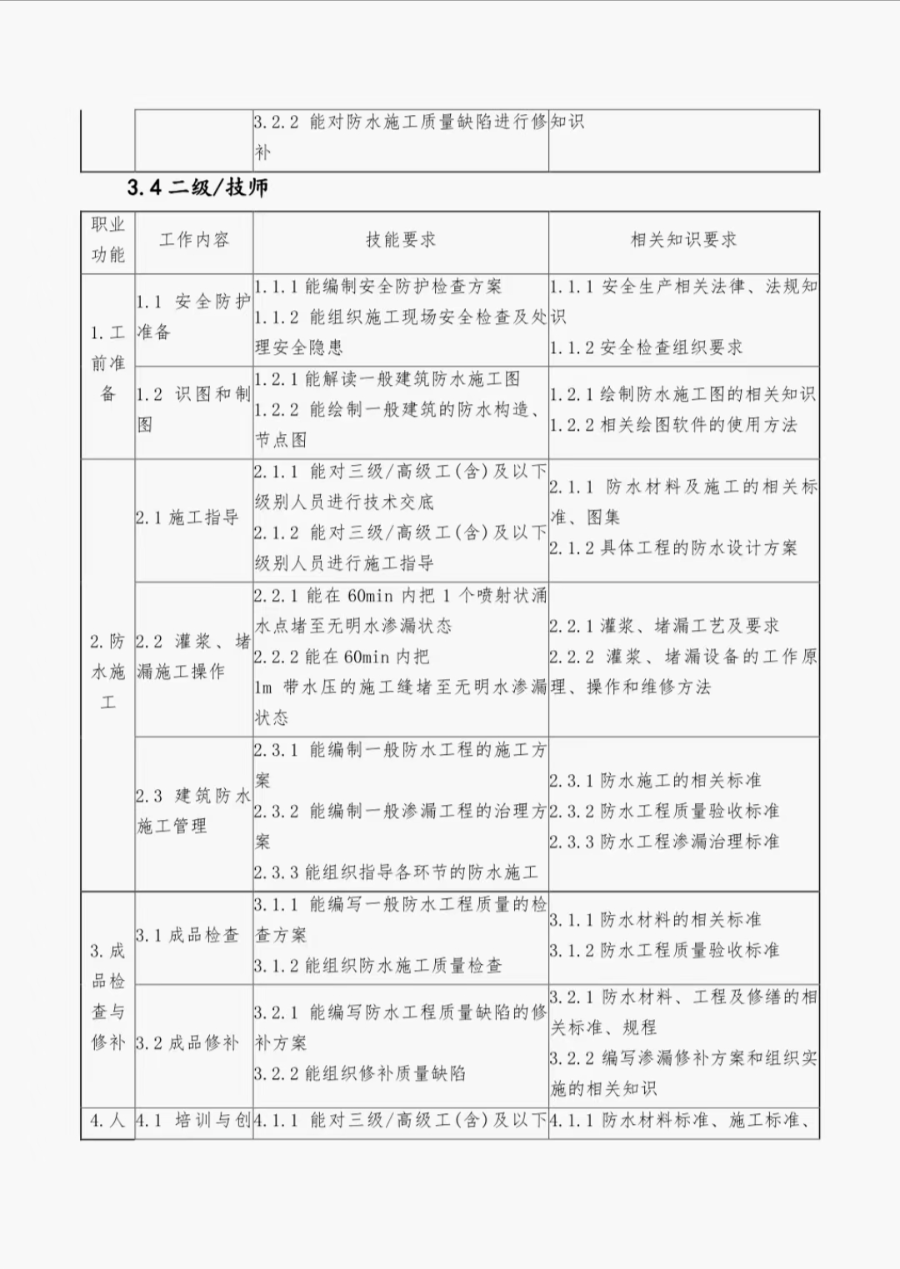
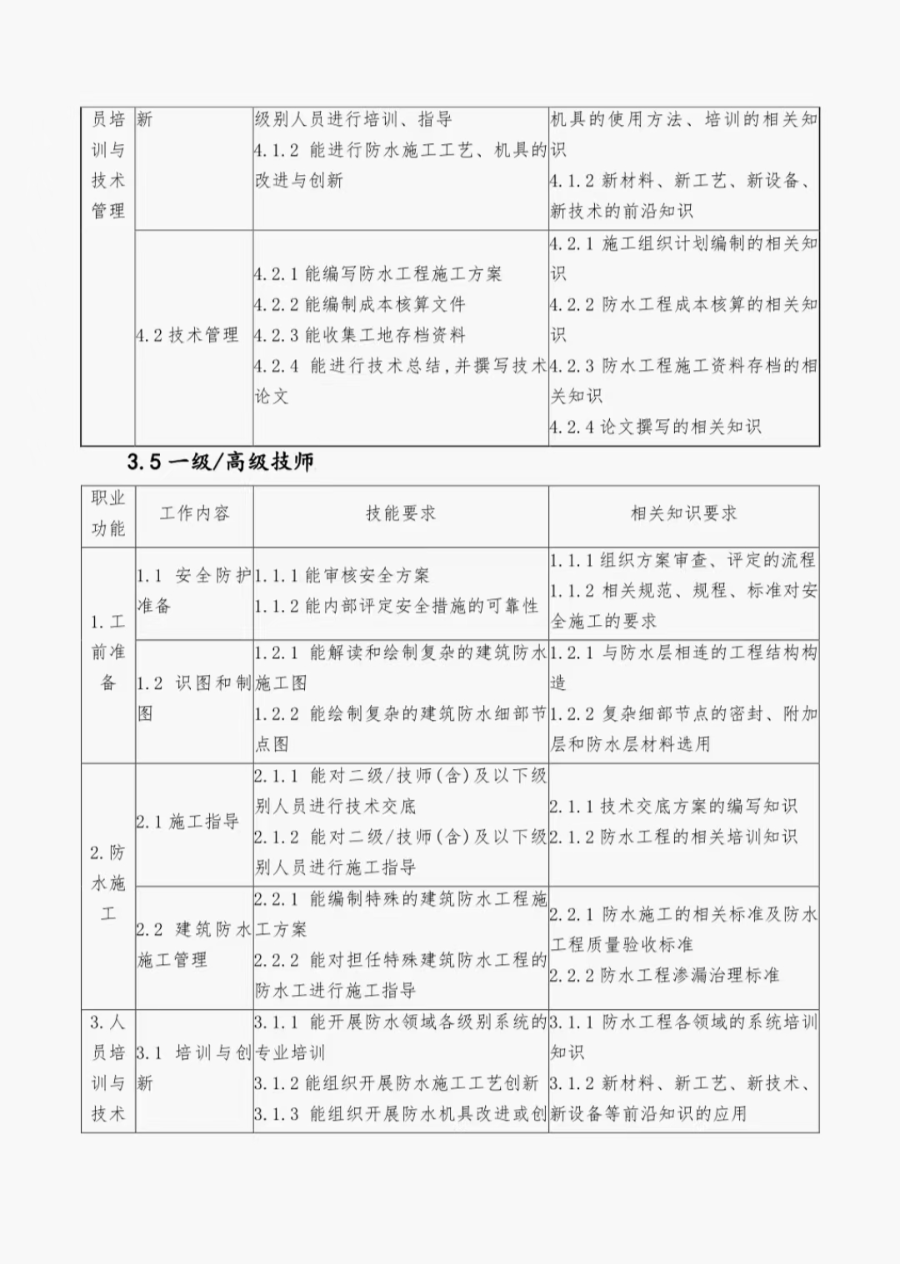
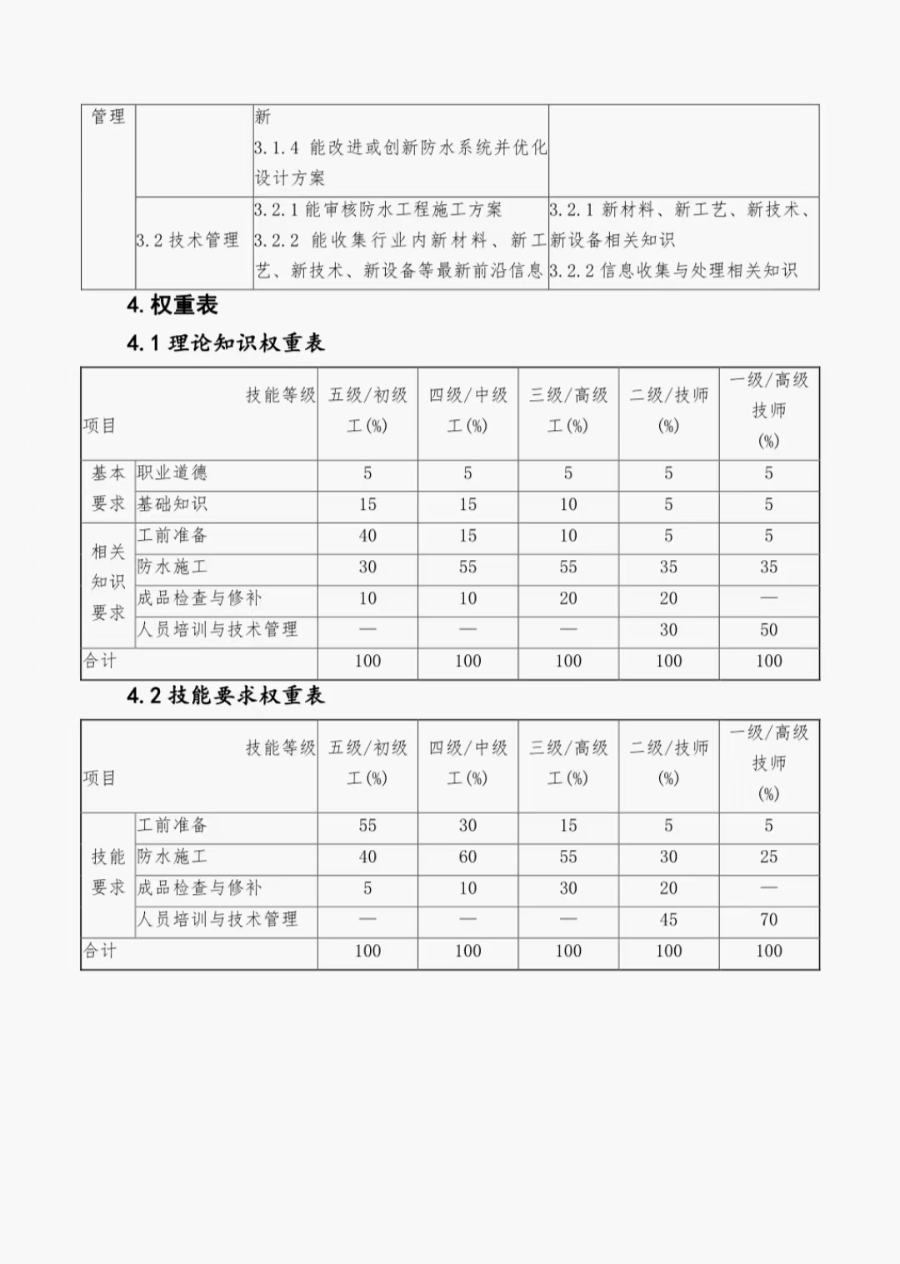
(Source: Ministry of Human Resources and Social Security, Ministry of Housing and Urban-Rural Development website, China Construction Waterproofing Association)

Latest News


Official Account
Chengdu:Huaqiao City, Jinniu District, Chengdu, Sichuan Province•Creative CenterABuilding 21, Floor 21 Manufacturing Base:No. 56 Xingye 7th Road, Industrial Economic Development Zone, Dayi County, Chengdu, Sichuan Province
Chongqing:Fujia No. 176, Haier Road, Jiangbei District, Chongqing68号 Manufacturing Base:No. 289 Qingsong Road, Tianjia Industrial Park, Tongnan District, Chongqing

National Consultation Hotline
028-87341118或15228990208
After-sales Service
400-0789-166
Copyright@ 2023 Sichuan Jinxing Waterproof Technology Group Co., Ltd. ShuICPBeian No. 2023005631-1


Baidu Baijiahao

Official Douyin
Mini Program Entry


15228990208